
ORBLED / CONCEPT WORKS
Bolting factories together in free fall.
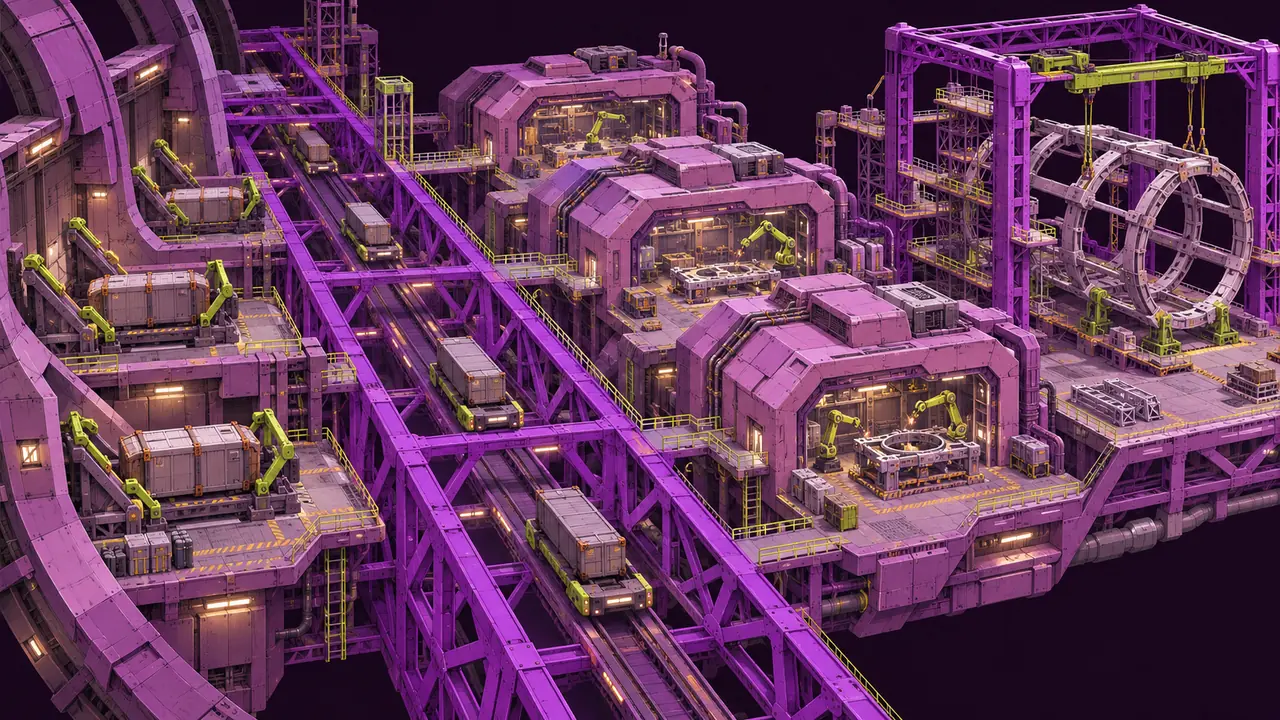
A factory in orbit cannot put its overflow behind the building. Everything that arrives needs a captured position, a clear approach and somewhere useful to go next. Orbled Studios explores industrial game concepts in which those practical relationships become the main event. The machinery is large, but the interesting decisions often begin with a small obstruction: a crate parked across a rail junction, a furnace waiting for a replacement feed sleeve, or an unfinished module occupying the only safe assembly berth.
Choose a working area
Our orbital yard panorama separates three connected spaces. Receiving catches arriving containers before they enter the internal transport system. Fabrication turns sorted stock into components, creating heat and taking time. Assembly gives those components a destination, provided the frame can remain accessible while crews attach the next section. Select a zone to inspect its role, then follow the corresponding concept page for the proposed player actions. The picture is concept artwork, not a live simulation or a released-game screenshot.
Freefall Yard: build around the next movement
In Freefall Yard, players arrange modular production equipment around a shared transport spine. Adding a machine increases capability without automatically improving throughput. Its service face may point toward an occupied berth; its output may arrive on the wrong side of an assembly frame. We want each expansion to offer a useful benefit and a legible spatial consequence. A successful yard has room to change its mind.
Dock Nine: access is part of the schedule
Dock Nine concentrates on the arrival and refurbishment of large orbital structures. A vessel can be ready for repair while the receiving berth is still unavailable. Players allocate temporary storage, reserve work envelopes and sequence handovers between inspection and assembly. This narrower setting lets us investigate the difference between a resource shortage and a coordination problem without hiding either behind a single efficiency score.
Follow the build record
Our Assembly Record groups design notes by the production question they address. Receiving notes examine how cargo enters the yard. Fabrication notes consider queues and by-products. Integration notes ask what happens when individually sound parts must become one working arrangement. These are proposed mechanics and design studies. The concepts do not currently have announced release dates, playable downloads or store listings.
What we inspect next
The next useful question is whether the interface can explain why a task is waiting. A paused production line should point to its missing condition, not merely turn red. We examine this through diagrams, short written scenarios and alternative layouts before claiming that any particular control scheme works.