
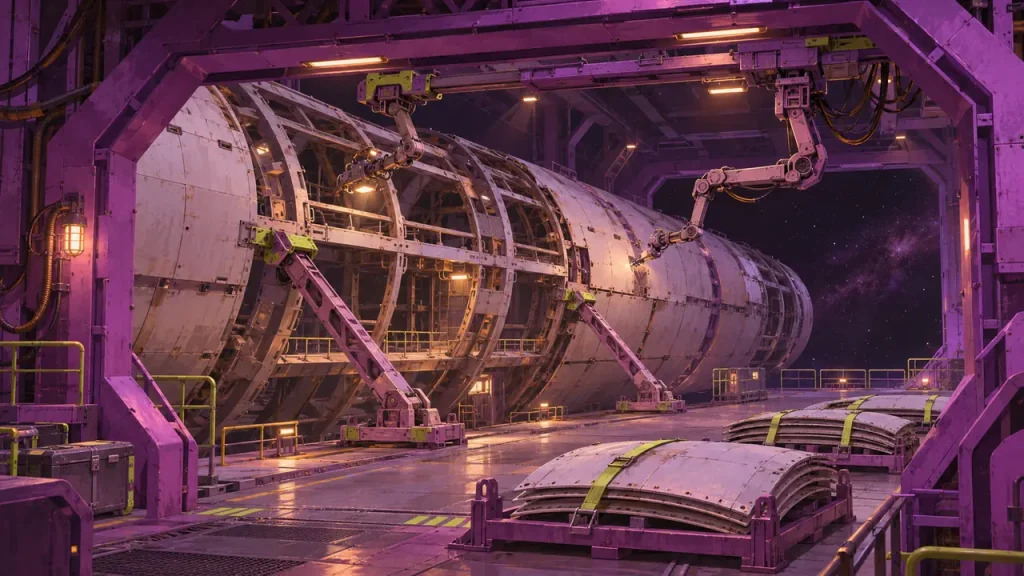
Dock Nine is a proposed orbital refurbishment game built around a simple constraint: a repair station cannot promise the same empty space twice. Large structures arrive with incomplete information. Some work can begin immediately, while other tasks need an inspection, a replacement component or a different orientation. The player manages the station between those discoveries. This is concept-stage material rather than an announcement of a finished product.
Admit work without trapping the yard
An arriving structure requests a berth and an approach corridor. The player compares that request with work already in progress, including temporary protrusions such as extended handling arms. An empty berth is not necessarily reachable. The admission view therefore combines destination and approach instead of showing them as unrelated permissions. A reservation remains visible until the structure is secured and the corridor can genuinely be released.
The proposed first loop is to review an arrival, reserve its envelope, position support equipment and admit it. Inspection then reveals the actual work sequence. Players can prepare for likely findings, but they cannot know every defect from the arrival label. We want uncertainty to change the order of practical tasks without making earlier planning meaningless. A flexible staging area becomes a useful response to incomplete knowledge.
Inspection changes the job
A damaged attachment may prevent the structure from rotating into its preferred service orientation. A replacement panel may be ready but inaccessible behind a temporary brace. Such findings would appear as explicit relationships in the job record. The player should be able to follow the obstruction to the affected movement, then compare alternatives. The goal is not to surprise players with arbitrary failure rolls after they have done everything correctly.
Inspection also creates a handover. The receiving crew has secured the object, but the assembly operation needs a different set of clearances. The proposed interface marks which reservations belong to the completed arrival and which must remain for the repair. Releasing everything at once would be unsafe; retaining everything would immobilize the station. That distinction is the centre of the concept.
Temporary stock still occupies somewhere
Removed parts need destinations even when they are no longer useful. We propose separate holds for reusable assemblies, uncertain items awaiting examination and material ready to leave. These categories are actions in the workflow, not cosmetic inventory colours. A part changes category when a decision is made about it. The storage arrangement should make those transitions visible and preserve a route back to the berth when reuse becomes appropriate.
A station made of work envelopes
The art direction treats the dock as a sequence of large frames around an exposed working volume. Incoming structures have distinct silhouettes so their occupied space can be judged at a glance. Overlays show approach corridors, tool reach and reserved movement separately. Only the selected relationship becomes visually dominant. We want the player to see both the object and the practical claim it makes on the surrounding station.
Coordination instead of a perfect timetable
An early plan is a hypothesis about how work can proceed. The proposed game lets players revise it as inspection produces better information. We are investigating how to show the consequence of moving one appointment without implying that every delay is a failure. A deliberate pause can protect access for a more important handover. The design should distinguish a useful reservation from abandoned work that nobody has released.
Current scope
Dock Nine remains a concept with written scenarios and visual studies. No release window, store listing or measured playtest result is claimed here. Read the system comparison to see how its temporary occupation differs from Freefall Yard, or visit the Assembly Record for notes on receiving, clearances and dependency communication.