
A Clear Berth Is Not a Clear Approach
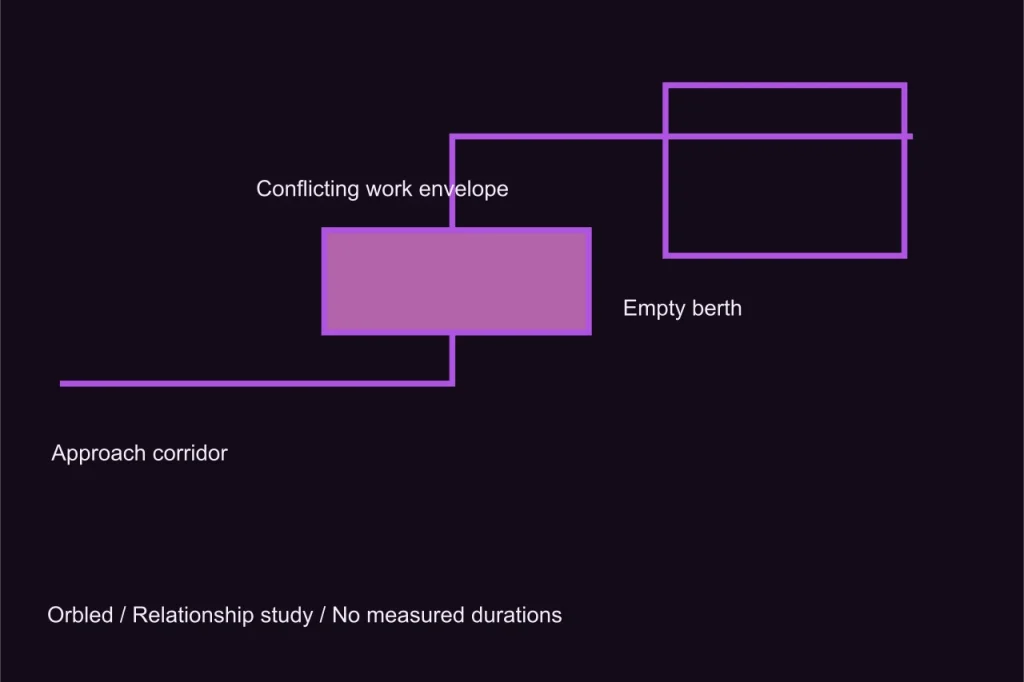
A berth can look empty while remaining unusable. A handling arm may extend across its approach. A parked container may leave enough room for a small carrier but not for the structure arriving next. If a game marks the berth as available without showing these relationships, the player receives contradictory information: the destination says yes, while the movement says no. This note examines that problem for the proposed receiving system in Dock Nine.
Start with a particular arrival
Imagine a replacement habitat frame approaching a refurbishment station. It needs a berth, but its width also requires a corridor through the outer work zone. Another job occupies a neighbouring berth and has extended a temporary brace into that corridor. Nothing is wrong with either job considered alone. The conflict appears only when the arrival is represented as a movement through space rather than a request for an empty destination.
The proposed interface should begin with the frame’s outline and its planned route. Selecting the destination would reveal the occupied segment that prevents access. The player could then inspect the brace and understand which active task requires it. This chain matters more than a generic warning. It connects the apparent contradiction to an object and a condition that can potentially change.
Reservations need a beginning and an end
A reservation is useful when it protects a specific transition. Holding an approach corridor while a structure is being captured makes sense. Keeping the same corridor unavailable after capture may not. We propose assigning a release condition to each reservation: secured at the berth, handling arm retracted, or transfer completed. The wording should describe a visible state rather than an unexplained timer.
This does not mean every reservation disappears automatically. Some movements create a new requirement after arrival. A frame may need rotation before inspection, and that rotation occupies part of the original corridor. The handover should show which claim ended and which one remains. Otherwise, automatic release becomes as misleading as indefinite reservation. A player needs to understand the difference between a forgotten hold and a continuing operational need.
Compare responses instead of offering one fix
The incoming frame might wait outside, use another berth or arrive after the brace is removed. Each response affects a different part of the schedule. Waiting preserves the existing repair sequence but delays admission. Changing berth can consume a longer internal route. Removing the brace early may interrupt work that depends on it. These are useful alternatives only if their consequences are visible before the player commits.
We do not want an interface that simply highlights the cheapest option and converts the decision into a confirmation click. The proposal instead shows the affected commitments. A player who understands the station’s current priorities can judge whether preserving one job is worth delaying another. The game’s rules must make those priorities concrete enough to support that judgement.
Keep the overlay smaller than the problem
Drawing every possible corridor at once would obscure the structure that the player is trying to move. The receiving view should therefore focus on the selected arrival. Conflicting reservations can appear one at a time as the player follows the dependency. An overview remains available, but it should summarise occupation rather than fill the screen with every potential path.
The illustration accompanying this note shows a destination, an approach and a conflicting work envelope as separate shapes. It is a conceptual relationship diagram, not a measured engineering clearance study. Its purpose is to make the distinction understandable before the visual design adds machinery, lighting and background detail.
What still needs investigation
The unresolved question is how much advance scheduling the player should control. A long reservation horizon could make coordination satisfying, but it could also turn every small change into administrative work. A short horizon keeps decisions immediate while reducing the value of preparation. The Dock Nine concept describes the broader setting. The Yard Systems comparison explains why this arrival-focused problem differs from routing continuous factory output.