
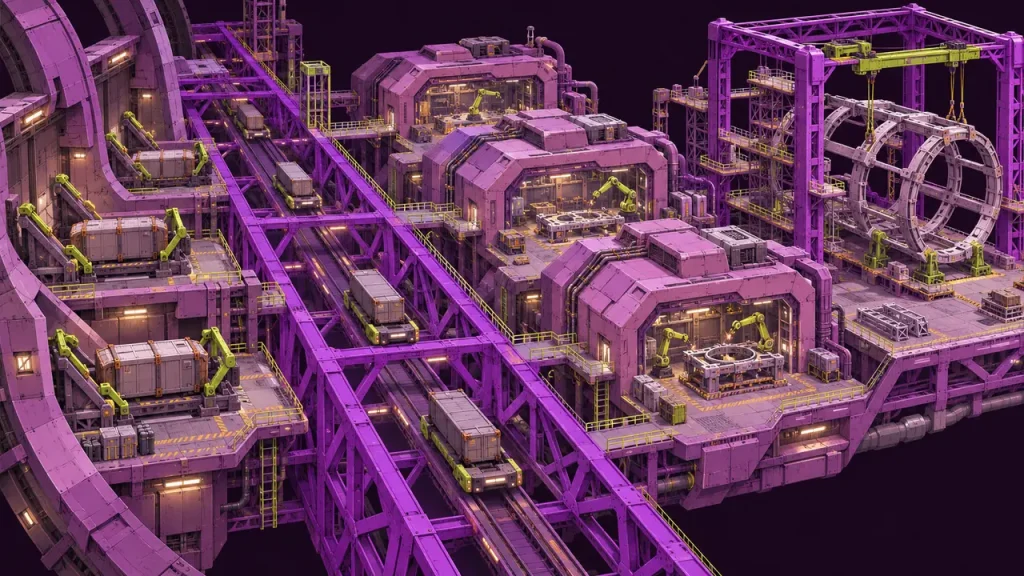
Freefall Yard is a game concept about assembling an industrial station while keeping it usable. The proposed setting is a construction orbit where imported stock arrives in irregular batches. Players do not control a self-sufficient city or an unlimited warehouse. They control a collection of machines, attachment frames and carriers that must repeatedly make room for one another. The current material is a design proposal, with no announced release date or publicly available playable build.
The receiving cycle
A delivery first occupies a capture cradle. Before moving it inward, the player inspects its container type, destination and handling requirements. Some stock can go directly to a processing module; other cargo needs sorting or a temporary hold. Releasing the cradle quickly is useful only when the resulting movement does not block a more urgent transfer further inside the yard. We want the first decision to connect an arrival to a route, rather than reward an automatic accept button.
Once a route is assigned, the interface would show the planned sequence of occupied positions. A blocked segment remains attached to a visible reason. The player can reroute the carrier, relocate stored stock or wait for a conflicting movement to finish. Each response changes a different part of the system. Rerouting spends distance, relocation adds handling work, and waiting consumes access time at the receiving end.
Expansion with a service face
Production modules attach to frames with a working face and a service face. The working face handles material; the service face must remain accessible for inspection and replacement. A machine can fit geometrically while being poorly placed operationally. In the proposed placement view, both envelopes appear before the commitment. This makes a future maintenance problem something a player can reason about, not a surprise penalty concealed behind attractive machinery.
Expansion should therefore create alternatives instead of one obvious upgrade path. A second processor may reduce a queue but put more output onto an already busy spine. A short bypass can improve movement without increasing manufacturing capacity. A buffer rack can absorb a delivery burst, provided it does not consume the room needed to retrieve its own containers. The useful choice depends on the current arrangement.
The orbital construction setting
Our concept yard uses open trusses, insulated processing pods and conspicuous handling fixtures. Gravity is not used as a visual excuse for objects drifting without purpose. Containers have attachment points and clear transfer relationships. The backdrop suggests scale and isolation, while the working area keeps boundaries readable. Violet structural light and warm inspection lamps separate the station silhouette from the places where a player must judge access.
Showing a waiting task
A production queue should answer three questions: what is waiting, which condition is missing, and what action could change that condition? We propose a dependency view that follows the selected task outward to its blocked route or unavailable berth. It should not expose every connection at once. The player starts with a concrete delay and expands only the relevant chain. A busy yard remains a place to inspect rather than a wall of simultaneous warnings.
Design goals and unresolved choices
The main design goal is understandable congestion. We still need to decide how much movement to automate and when a player should approve a reroute. Too much manual handling could bury the interesting placement decisions; too much automation could make those decisions invisible. The Assembly Record documents these questions as proposals. Dock Nine explores the related problem through temporary repair berths instead of a growing production network.