
Follow the Queue to Its Condition
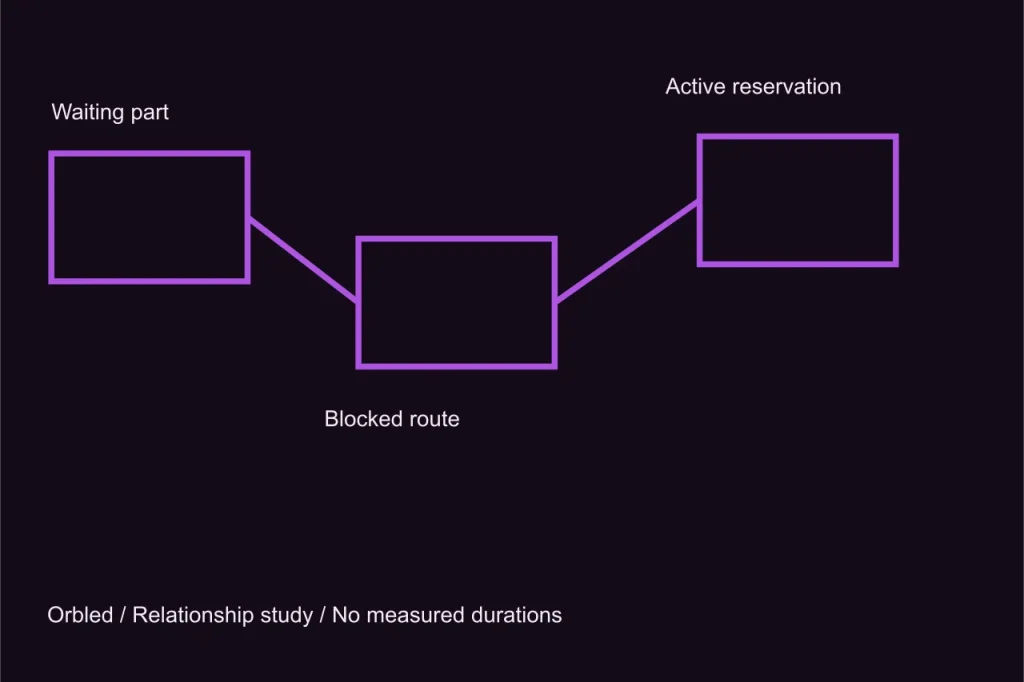
A queue tells a player that work is waiting. It does not necessarily explain why. In an orbital factory concept, a component might be delayed by missing stock, an occupied transfer position, a reserved assembly frame or a processing stage that has not finished. Presenting all those cases as the same red progress bar makes the factory look simpler while making decisions harder. This note proposes a more specific way to inspect a pause.
Begin with the selected job
Consider a support ring waiting for installation. Its raw stock is available and its processing step is complete. The ring remains in a holding fixture because the carrier cannot enter the assembly zone. The assembly zone is reserved for a frame rotation, and that rotation is waiting for a temporary brace to be released. The meaningful explanation is a chain of conditions, not a shortage of production capacity.
The interface would begin with the support ring and offer a link to its next missing condition. Following that link would reveal the carrier route, then the reservation, then the brace. The player controls how far to trace the chain. A compact initial explanation remains readable, while deeper inspection stays available when the first cause is not enough to choose a response.
Distinguish a cause from a useful intervention
The final object in a dependency chain is not always the thing the player should change. Releasing the brace could disrupt an important operation. An alternative carrier route might solve the ring’s delay without touching that work. We therefore want the inspection view to explain the cause while leaving room for interventions elsewhere. A diagnosis is not the same as an instruction.
This distinction helps avoid a common interface trap: marking one object as the problem can imply that removing it is always correct. In a connected yard, an object can be performing a necessary role and still prevent another task from proceeding. The interesting decision concerns priorities and alternatives. The display should preserve that context instead of turning coordination into a hunt for the highlighted obstruction.
Show what changes after an action
If the player chooses a reroute, the preview should show which condition becomes satisfied and which new movement is introduced. It should not promise that every downstream job will immediately finish. Other conditions may remain. A useful preview is bounded: this carrier can reach the holding fixture, this transfer position becomes occupied, and the ring can advance to the next stage.
Bounded explanations also make cancellation clearer. If a player cancels a reservation, the interface can show which pending movement loses its protected space. That is more informative than a generic confirmation warning. The system becomes a set of understandable commitments rather than a collection of buttons whose consequences are revealed only after use.
An overview still has a role
A focused dependency view cannot replace the whole-yard picture. Players need to notice patterns such as several queues depending on the same transfer junction. The overview should summarise those concentrations without drawing every dependency edge simultaneously. Selecting a concentration can then open the specific jobs behind it. We are exploring this relationship between summary and inspection in written scenarios before choosing a final interaction model.
The illustration for this entry is a proposed chain of dependencies. Its nodes represent task states, not measured durations or validated throughput. Keeping that distinction explicit lets the diagram explain an idea without pretending to supply results from a simulation that does not yet exist.
Continue the investigation
The wider Freefall Yard concept describes how placement and movement interact. The note Give the Service Face Room examines an earlier opportunity to make one such dependency visible. Together they ask whether players can understand a problem before the interface asks them to solve it. That remains a design goal, not a reported playtest outcome.