
Give the Service Face Room
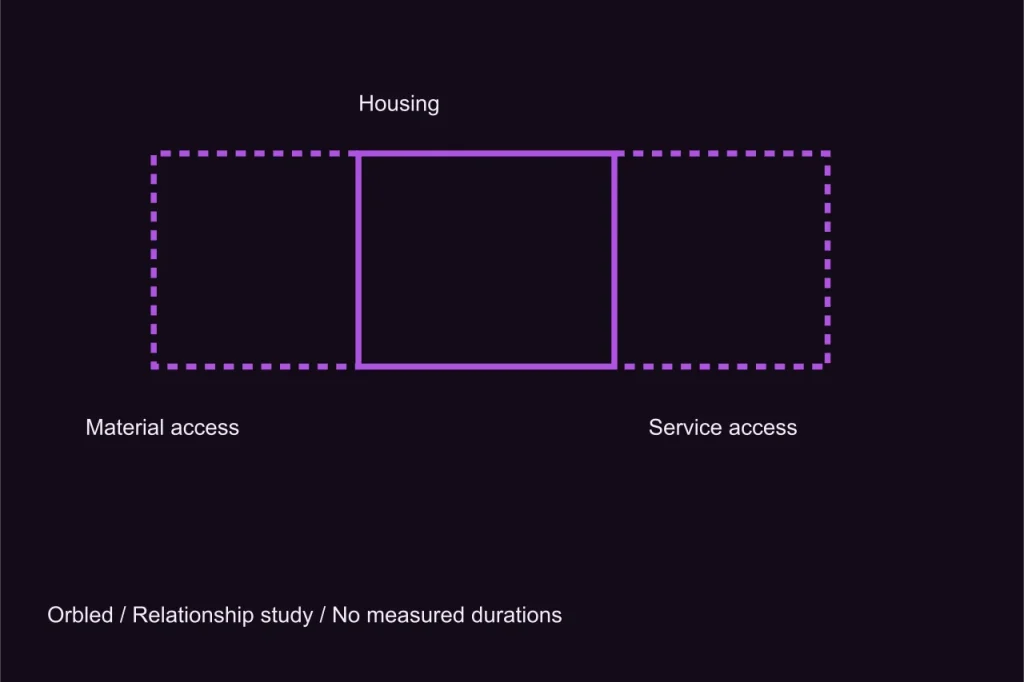
A production module is more than the space occupied by its housing. It also needs somewhere for material to enter, products to leave and maintenance work to happen. A placement tool that checks only the housing can approve an arrangement that immediately creates a hidden access problem. For Freefall Yard, we are considering how the placement view can communicate those different claims without making construction feel like filling out a technical form.
Two faces, two purposes
The working face of a proposed processing module connects to the material network. The service face provides access to replaceable components and inspection points. They are separate because a busy material route should not automatically become the only place from which the machine can be maintained. The player should see both relationships while considering the module’s orientation.
An early diagram uses a solid outline for the housing and a translucent region for the service envelope. That distinction is intentional. The housing always occupies space; the service envelope protects a future operation. Treating both as permanently solid would make the yard unnecessarily rigid. Treating the envelope as decoration would hide the cost of building across it. The proposed rules need to make its status explicit.
A warning should describe the blocked action
Instead of saying that placement is inefficient, the interface could explain that the inspection hatch would be inaccessible while a neighbouring rack is occupied. This wording names a condition and an operation. It also suggests a possible response: keep the rack temporary, move it elsewhere or choose another orientation. The player gains a practical choice rather than an abstract penalty.
Some arrangements may remain valid with a temporary obstruction. We are not proposing that every service envelope must be empty at all times. A maintenance plan could include moving a small rack before opening the hatch. The important requirement is that the game remembers and communicates that dependency. A known relocation task is different from a machine that cannot be reached at all.
Expansion changes the meaning of old space
An open area beside the first processor may seem wasteful when the yard is small. Later, it can become the place where a carrier turns, a replacement part waits or an inspection tool approaches. The game should help players recognise those uses without declaring every empty cell sacred. We want flexible space to have value, but not through an invisible bonus attached to leaving gaps.
One possible view highlights the activities that have recently used an area. Another previews the activities a proposed module would need. Neither is a prediction of every future event. They are ways to connect a spatial decision to known operations. This makes an expansion review about the changed relationships rather than the simple increase in machine count.
Make the art support the rule
If the service face matters, it needs a visual identity. Access panels, grab fixtures and tool attachment points should be placed where the rule says they are. A beautiful model with indistinguishable sides would force the interface to carry all the explanation. Conversely, an oversized warning stripe on every surface would make the machinery harder to read.
Our current direction reserves strong accent colour for a small number of handling features. Structural violet defines the module’s overall shape, while warmer light marks active work areas. The accompanying diagram isolates the housing and two envelopes before any material treatment is applied. It is a design study, not a claim that the arrangement is safe for a real industrial installation.
Where this question leads
The next design question is whether service access should be planned during initial placement or reviewed through a separate maintenance mode. Both have costs. A richer placement view can become crowded; a separate mode can let players miss a crucial relationship. Read Freefall Yard for the proposed production loop and Assembly Office for how we separate visual development from unverified claims about playability.