
Finished Work Must Release Its Space
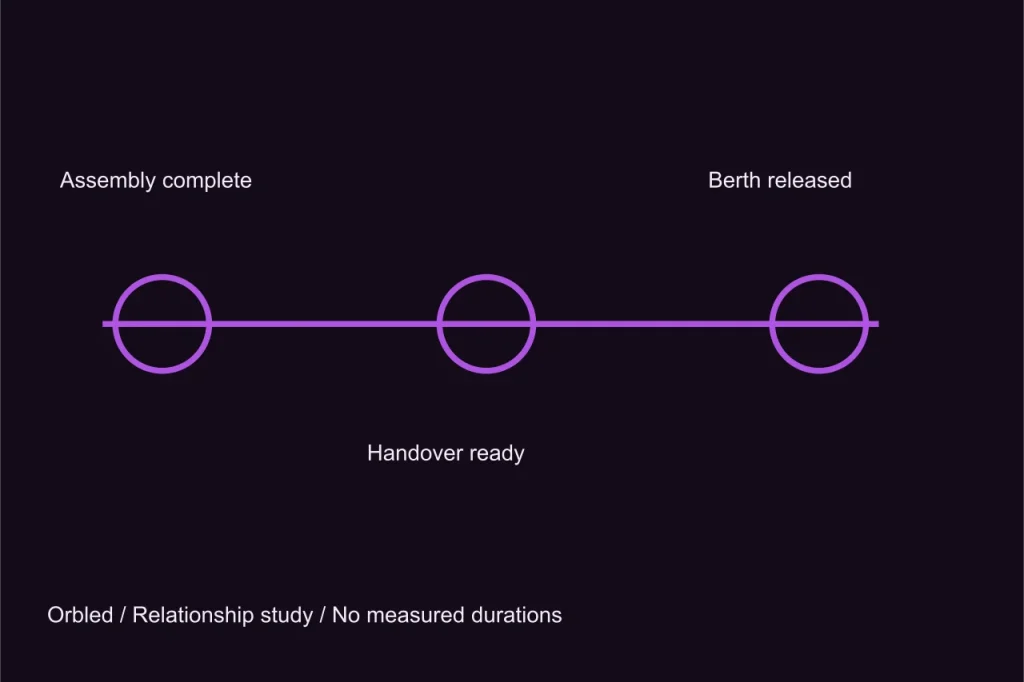
A job can be marked complete while its equipment still occupies the work site. A carrier remains parked, removed parts wait beside the frame and an approach corridor stays reserved even though the arrival is over. If a game celebrates completion at the moment the final component is attached, it may omit the operation that makes the station useful again. Dock Nine treats that release as a design question in its own right.
Completion has several meanings
The repaired structure may be mechanically assembled but still need an inspection. The inspection may be finished while handling equipment remains attached. The structure may be ready to leave while its departure route is occupied. These are different states, and collapsing them into a single completed label can mislead the player about what space is actually available.
Our proposal separates assembly complete, ready for handover and berth released. Each state has a practical consequence. Assembly complete allows the inspection sequence to begin. Handover readiness confirms that the required support and access conditions are satisfied. Berth release means that the structure and temporary equipment no longer claim the working volume. The labels should remain short, but their meaning must be visible in the station.
Clear the temporary objects deliberately
During a repair, temporary fixtures solve real problems. A brace stabilises an awkward structure; a nearby rack holds removed panels in a useful order. Clearing them too early can make the job harder or impossible. Leaving them indefinitely can block unrelated work. The proposed release checklist therefore belongs to the particular job and records why each temporary object is still needed.
This is not intended as a long series of repetitive confirmation clicks. Routine clearing could be grouped once its conditions are met. The important decision is whether the group is ready to release and where its objects will go. Automation can carry out the movement after the player understands the handover. It should not silently erase stock or make equipment disappear from the yard.
Departure is another arrival in reverse
A finished structure needs an exit route just as an incoming one needs an approach. The route can differ because the object’s shape has changed during assembly. A compact set of delivered components may leave as a large frame. Planning only for the incoming dimensions would miss that consequence. The concept’s berth view should show the intended final envelope before the player commits to the job.
The departure plan also affects other reservations. Holding a corridor too early reduces usable capacity; leaving it too late can strand finished work at the berth. We want the player to balance those effects through visible commitments. The objective is not to discover one perfect schedule but to keep the station able to respond when a task takes a different route through its conditions.
Avoid rewarding abandoned cleanup
If only assembly progress contributes to a score, players may learn to begin more jobs while leaving the release work behind. The system would reward the wrong behaviour and then punish the resulting congestion. We would rather make the value of release tangible: another structure can enter, a tool returns to service and a transport route becomes usable again. Those changes are meaningful without inventing a separate cleanup bonus.
The illustration maps a handover through three states and shows which spatial claims remain in each. It deliberately leaves out numerical durations. At this concept stage, the purpose is to test the clarity of the relationship in a design discussion, not to present a tuned scheduling model or a measured performance improvement.
Connect the beginning and the end
Read A Clear Berth Is Not a Clear Approach for the receiving side of the same problem. The Dock Nine dossier explains why temporary occupation forms the centre of this concept. A station is not made flexible merely by adding empty berths. It becomes flexible when the work occupying those berths has understandable conditions for arriving, changing and leaving.